
Sapiens by Yuval Noah Harari
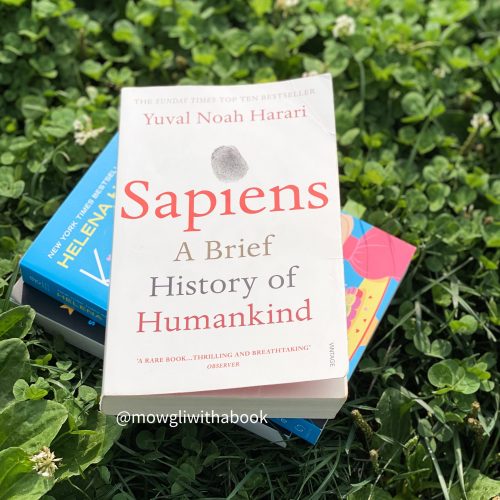
Publisher – Harper Perennial
Publication Date – February 10, 2015
Genres – History, Non-fiction, Science, Anthropology, Biology, Sociology
Audiobook Narrator – Derek Perkins
⭐️Contemplative, Convincing, Comprehensive⭐️
If you don’t remember anything from your school history, economics or political studies, don’t worry – because Yuval walks through all of these and a lot more in his stunning book – Sapiens!
⭐️⭐️⭐️⭐️⭐️/5
SYNOPSIS->
One hundred thousand years ago, at least six different species of humans inhabited Earth. Yet today there is only one—homo sapiens. What happened to the others? And what may happen to us? Most books about the history of humanity pursue either a historical or a biological approach, but Dr. Yuval Noah Harari breaks the mold with this highly original book that begins about 70,000 years ago with the appearance of modern cognition. From examining the role evolving humans have played in the global ecosystem to charting the rise of empires, Sapiens integrates history and science to reconsider accepted narratives, connect past developments with contemporary concerns, and examine specific events within the context of larger ideas. Dr. Harari also compels us to look ahead, because over the last few decades humans have begun to bend laws of natural selection that have governed life for the past four billion years. We are acquiring the ability to design not only the world around us, but also ourselves. Where is this leading us, and what do we want to become?
REVIEW->
Never before has a nonfiction book been this informative and easily digestible as Sapiens. The plethora of information and analysis this book offers is amazing. Reading the book, you can’t help but marvel at the intricacy of evolution, and the complications introduced by Homo sapiens – that have actually enabled and aided our survival.
It is important to remember that anything about history, told by connecting dots, are theories postulated by historians, archaeologists, economists and many other researchers. These are not necessarily set in stone, but are a rational explanation for what we know today. I would be surprised if there aren’t a few theories contradicting Yuval’s claims today. So read it with an open mind to know. Because unless you know first, you aren’t enabled to think or analyze.
The Writing ->
The writing of this book is excellent. This is the most easily readable nonfiction I have come across. Despite having technical terms and tons of jargon, the storytelling technique is extensively employed in the book and the reader is left clear and unconfused. Be it the industrial revolution, scientific revolution or understanding the basis of war – this book will give you a glimpse into everything. It also discusses what it means to be happy and why we drive for evolution.
I highly recommend reading Sapiens. It took me almost a year to read through this, simply because I only read it in parts, but it is not to be classified as a difficult read. It is a Gates recommended book too.
Favorite quotes from the book->
“The wandering bands of storytelling Sapiens were the most important and most destructive force the animal kingdom had ever produced”
“The first universal order to appear was economic: the monetary order. The second universal order was political: the imperial order. The third universal order was religious: the order of universal religions such as Buddhism, Christianity and Islam”
“Most scientific studies are funded because somebody believes they can help attain some political, economic or religious goal.”
“So perhaps happiness is synchronizing one’s personal delusions of meaning with the prevailing collective delusions”
About The Author

Professor Harari was born in Haifa, Israel, to Lebanese parents in 1976. He received his Ph.D. from the University of Oxford in 2002, and is now a lecturer at the Department of History, the Hebrew University of Jerusalem.
He specialized in World History, medieval history and military history. His current research focuses on macro-historical questions: What is the relation between history and biology? What is the essential difference between Homo sapiens and other animals? Is there justice in history? Does history have a direction? Did people become happier as history unfolded?
Prof. Harari also teaches a MOOC (Massive Open Online Course) titled A Brief History of Humankind.
Prof. Harari twice won the Polonsky Prize for Creativity and Originality, in 2009 and 2012. In 2011 he won the Society for Military History’s Moncado Award for outstanding articles in military history
You can find the Author on Her Website, Instagram, Twitter, Goodreads
Find the Book on Barnes and Noble, Amazon